Bravery Before Confidence: Desensitization in Stuttering Therapy
One of the most common things people hope for in stuttering therapy is confidence.
Parents want their child to feel confident speaking in class. Teens want confidence talking with peers. Adults want confidence during meetings, phone calls, or introductions.
Fluency is often treated like the prerequisite for confidence: “Once I’m more fluent, then I’ll speak up.”
In reality, fluency is not the key to confidence. It’s bravery.
Bravery is the act of feeling fear and doing it anyway.
That is where desensitization comes in.
What Is Desensitization?
Desensitization is the process of gradually reducing fear, avoidance, and emotional distress related to stuttering. (Think of it as melting the “iceberg.”)
Many people who stutter are not only reacting to the physical experience of stuttering itself. They are also reacting to fear of judgment and embarrassment. They are reacting to negative thoughts of what might happen if they stutter and what their listener might think.
Over time, these fears can lead to avoidance. A person may avoid certain words, people, and places. They may avoid speaking altogether in some situations.
The problem is that avoidance often teaches the brain: “This situation really was dangerous.”
And the fear grows.
Desensitization works by helping a person safely approach feared speaking situations rather than escaping them.
The goal is not to eliminate anxiety completely. The goal is to help the speaker learn:
“I can stutter and still communicate.”
“I can tolerate discomfort.”
“I can survive awkward moments.”
“People’s reactions are manageable.”
“Stuttering does not have to control my choices.”
What Does “Showing Stuttering” Mean?
One powerful form of desensitization in stuttering therapy is showing stuttering.
Showing stuttering means reducing the effort to hide it.
For many people who stutter, a tremendous amount of energy goes into concealment. A person may switch words, start over, pretend to forget what they were saying, push through tension, avoid eye contact, and the list goes on.
Showing stuttering moves in the opposite direction.
Instead of hiding, the speaker practices allowing stuttering to be more visible and more open.
This might include:
Staying on a stuttered moment instead of escaping it
Maintaining eye contact during stuttering
Voluntarily stuttering at times
Disclosing stuttering to others
Using the word they originally wanted to say instead of substituting it
This can feel incredibly vulnerable at first. But it also creates opportunities for new learning.
When a person shows stuttering and they discover:
The world does not collapse
Communication still happens
Discomfort is survivable
That’s when fear often begins to loosen its grip.
Bravery Before Confidence
A common misconception is that therapy should wait until someone feels ready.
But confidence rarely appears spontaneously.
In many cases, confidence is built through repeated experiences of:
Feeling a tolerable amount of fear
Doing something brave anyway
Discovering the outcome was manageable
In other words: Confidence is often the result of action, not the prerequisite for it.
This is especially important for children who stutter. If a child learns early that speaking while uncomfortable is safe and supported, they may develop far less avoidance over time.
The goal is not to force people who stutter into overwhelming situations. Instead, the goal is to help them build tolerance for discomfort in gradual, supportive ways.
How I Structure Desensitization in Therapy
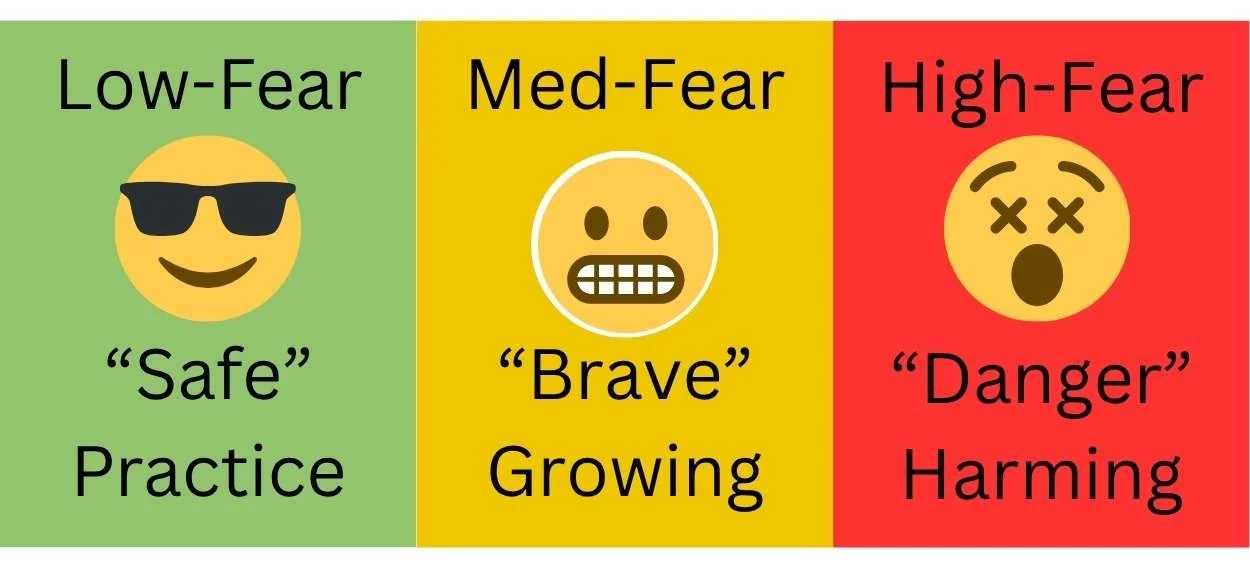
In my therapy, I use a fear hierarchy divided into three zones:
Green Zone (“Safe Zone”)
These are low-fear speaking situations.
The speaker feels safe in these situations. “Showing stuttering” in these situations may be considered relatively low-risk.
The green zone often includes the people we feel closest to, such as a parent, partner, or friend.
The purpose of the green zone is to build early success and develop willingness. It is in the green zone that we learn and practice new therapy skills before building bravery in the yellow zone.
Yellow Zone (“Brave Zone”)
These are moderate-fear situations.
The speaker experiences more noticeable discomfort, vulnerability, or anticipation. Often, with some planned and intentional “bravery,” the speaker is able to tolerate the discomfort enough to speak and participate fully.
Everybody’s yellow zone looks different, but examples might include:
Talking with less familiar peers
Making a phone call
Speaking in a small group
Ordering food at a restaurant
This is often where meaningful growth begins to happen. In intentionally learning to tolerate small amounts of discomfort for these speaking scenarios, the discomfort actually decreases over time. Eventually, what was once a “yellow zone” speaking scenario becomes a “green zone” scenario where the speaker experiences little-to-no fear or discomfort.
In other words, bravery turns into confidence.
Red Zone (“Danger Zone”)
These are high-fear situations.
These speaking moments may feel highly emotionally charged or overwhelming. Speakers may experience a “fight, flight, or freeze” response. Intense sensations or difficult memories may arise in these situations.
Everybody’s red zone looks different, but examples might include:
Public speaking
Classroom presentations
Job interviews
Difficult social interactions
Speaking to authority figures
Speaking to a romantic interest
Importantly, red-zone situations are not something a person is pushed into prematurely. This harms therapist-client trust and can create setbacks in therapy. Therapy should feel collaborative and supportive, not coercive.
As speakers practice desensitization and shift yellow zone speaking scenarios into the green zone, red zone speaking scenarios naturally shift into the yellow zone. As the speaker experiences success with moderately feared speaking scenarios, red zone scenarios that once felt daunting begin to feel more achievable. At some point, it will be the client’s idea to practice desensitization skills to directly target “public speaking” and “speaking to authority figures.”
But that’s for the future. In the meantime, the bravest thing is simply identifying a red-zone fear, talking openly about it, and choosing to “show up” in these scenarios.
Desensitization Is Not “Giving Up” on Stuttering
People sometimes misunderstand desensitization as, “You’re just teaching people to accept stuttering instead of helping them.”
That is not the goal.
Desensitization is about reducing the fear and struggle surrounding communication so that the person has more freedom, flexibility, and agency.
Ironically, when fear and avoidance decrease, communication often becomes easier and more spontaneous. As speakers stop avoiding stuttering, they may actually become more fluent.
But more importantly, the person’s life becomes bigger.
They participate more, avoid less, take more social risks, advocate for themselves, and communicate more authentically.
Final Thoughts
Stuttering therapy is not simply about changing speech patterns.
It is also about helping people rebuild their relationship with communication.
Desensitization helps create space for a powerful realization: “I do not need to wait until I am fluent in order to speak with confidence.”
Sometimes fluency comes later.
First comes bravery.
Ready to “practice bravery” and take the next step toward confident communication? I offer free consultation calls for individuals and families across Washington state, including state-wide teletherapy and in-person speech therapy in the North Seattle area.
